Latest posts:
Ski Areas in the Alps Where You Can Ski in Two Countries on the Same Day
Ski Areas in the Alps Where You Can Ski in Two Countries on the Same Day
Skiing in the Alps is not just about fantastic slopes, spectacular mountains, delicious food and charming Alpine villages. In some places, you can even experience skiing in two different countries on the same day. For example, you can start your morning skiing in Switzerland, enjoy lunch in Italy and then cross back over the border before the lifts close. Or why not start in France and spend the afternoon on Italian or Swiss slopes?This is possible because several of the Alps' best-known ski areas extend across national borders, with lifts and pistes connecting resorts in different countries. For skiers, this means not only more slopes to choose from but also the opportunity to discover different food cultures and surroundings without having to get into a car.
Here, we take a look at five ski areas where you can ski in two countries on the same day, along with some practical tips on ski passes, border crossings and other things worth knowing.

Zermatt and Cervinia - Switzerland and Italy
Few ski areas in the world can rival the combination of spectacular mountain scenery and fantastic skiing offered by Zermatt and Breuil-Cervinia. The two resorts lie on opposite sides of the Swiss-Italian border, with the iconic Matterhorn, or Monte Cervino as it is known in Italian, as the undisputed main attraction.The interconnected ski area offers around 360 kilometres of pistes in total, spread across Zermatt on the Swiss side and Cervinia and Valtournenche on the Italian side. For example, you can start your day skiing with views of the Matterhorn from Switzerland before enjoying long, wide runs on the Italian side later in the day.
One of the main highlights is the opportunity to cross the border via the high-altitude area around Klein Matterhorn and Plateau Rosa. Using the lifts, you can travel between the two countries at an altitude of over 3,000 metres, surrounded by glaciers and some of the highest and most beautiful peaks in the Alps.
The differences between the resorts also make the experience particularly interesting. Zermatt offers an exclusive Alpine atmosphere with traditional Swiss chalets, while Cervinia has a more relaxed Italian feel. A popular option, if you are starting on the Swiss side, of course, is to enjoy lunch at an Italian mountain restaurant before returning to Switzerland.
Ski pass: To ski in both countries, you need the international ski pass, known as the International Ski Pass. Keep in mind that a standard Zermatt ski pass does not automatically include the Italian ski area.
Important to know: As the border crossing is located at high altitude, it is exposed to the weather and can close in poor conditions. It is therefore best to check its status and the time of the last possible return connection in the morning before setting off.
Portes du Soleil - France and Switzerland
Portes du Soleil is one of the largest ski areas in the Alps, encompassing no fewer than twelve resorts spread across France and Switzerland. With around 600 kilometres of marked pistes, it is a paradise for skiers who enjoy variety and long days of exploration.On the French side, you will find resorts such as Avoriaz, Morzine, Les Gets and Châtel, while Champéry, Morgins and Les Crosets are among the best-known resorts on the Swiss side.
One of the great advantages of Portes du Soleil is that crossing the border feels like a natural part of the skiing experience. For example, you can start your day in Avoriaz, head across to Les Crosets in Switzerland and then continue back into France. From Châtel, it is also possible to cross over towards Morgins.
The skiing ranges from wide, family-friendly runs and forest pistes to much more challenging alternatives. On the Swiss side, you will find the famous steep run Le Mur Suisse, also known as the Swiss Wall, at Pas de Chavanette.
Portes du Soleil is particularly well suited to skiers who enjoy longer excursions and want to discover new parts of the ski area every day. However, it is important to plan your routes carefully, as distances can be considerable and not all parts of the area are directly connected by lifts.
Ski pass: To move freely throughout the entire ski area, you need a ski pass covering all of Portes du Soleil. Cheaper local ski passes are also available, some of which include parts of the ski area on both sides of the border.
Important to know: The ski area is vast. Check the connections and allow plenty of time to return to the resort where you are staying.
Ischgl and Samnaun - Austria and Switzerland
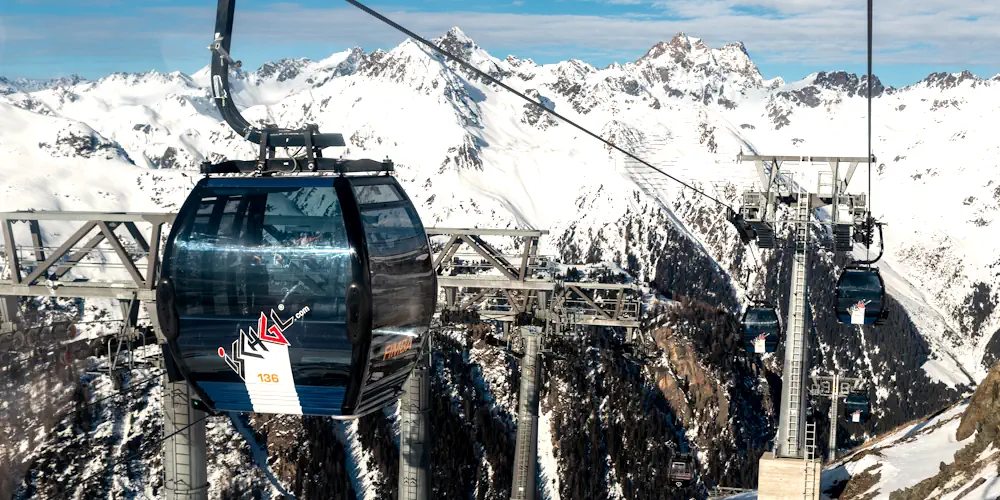
Ischgl is one of Austria's best-known ski resorts, not least thanks to its combination of modern lift infrastructure, reliable snow conditions and lively après-ski scene. But what many people may not realise is that the ski area actually extends all the way into Switzerland.Together with the Swiss resort of Samnaun, Ischgl forms the Silvretta Arena ski area, with a total of around 239 kilometres of pistes. Here, you can easily switch between Austrian and Swiss slopes during the same ski day. From Ischgl, you head up towards Idalp and onwards to the higher parts of the ski area. From there, you can continue across the border to Samnaun, which is located in the Swiss canton of Graubünden.
Samnaun is particularly well known for being a duty-free shopping destination, making the village an interesting excursion even for those who want to combine skiing with shopping. But there is also excellent skiing here, with long runs and plenty of challenges for more experienced skiers.
One of the advantages of Ischgl-Samnaun is how seamlessly the border crossing is integrated into the ski area. You hardly need to think about where the border is until you notice the signs or Swiss flags.
Ski pass: Ski passes for the Silvretta Arena Ischgl-Samnaun are valid on both sides of the border. There are also larger ski passes that cover additional ski areas in the region.
Important to know: Although Samnaun is duty-free, special customs regulations apply to goods taken across the border. It is also wise to check which lifts you need to take to get back to Ischgl.
La Rosière and La Thuile - France and Italy
For those who want to combine French and Italian skiing without visiting one of the very largest ski areas, France's La Rosière and Italy's La Thuile are a very interesting option. The two resorts are connected by the Espace San Bernardo ski area, which offers more than 150 kilometres of pistes on both sides of the border.The French resort of La Rosière sits on a sunny slope above the Tarentaise Valley and is particularly popular with families and skiers who prefer wide, relatively easy runs. Italy's La Thuile has a somewhat different character, with more steep sections and several really long descents.
The border is crossed near the Petit Saint-Bernard Pass, a historic mountain pass that has connected France and Italy for centuries. In winter, skiers travel between the two countries using skis and lifts, while the road over the pass is normally closed due to snow.
One of the most enjoyable aspects of the experience is the contrast between the two sides. You can start the morning with French croissants, enjoy Italian pasta for lunch and then return to finish the afternoon on the French slopes.
Ski pass: The Espace San Bernardo ski pass is valid in both countries. When purchasing a ski pass for two or more consecutive days from La Rosière, the entire international ski area is normally included.
Important to know: The cross-border connection is weather-dependent, and specific rules apply on the Italian side, including requirements for helmets and liability insurance.
©
Montgenèvre and Monti della Luna - France and Italy
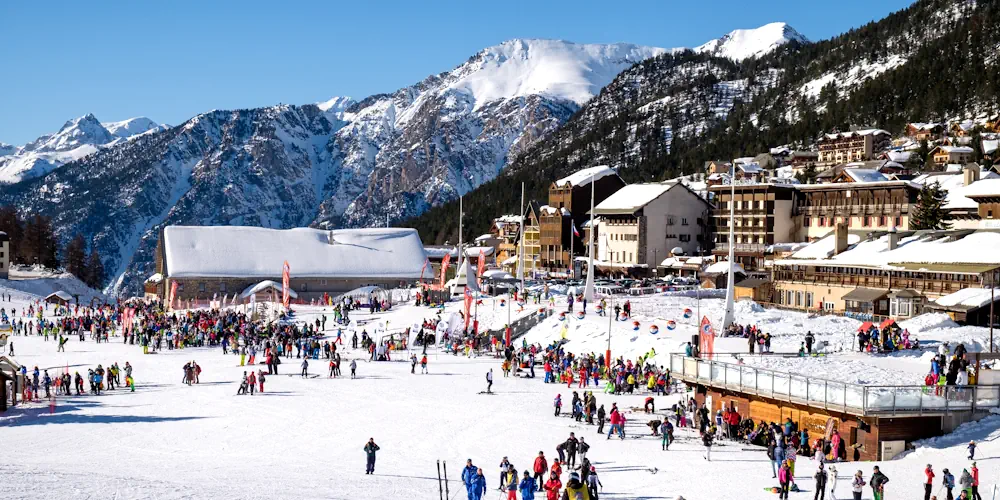
Close to the French-Italian border, not far from Briançon, lies Montgenèvre. It is one of France's oldest ski resorts and offers something rather unusual: the opportunity to ski between two countries without having to cross an extremely high mountain pass.Montgenèvre is part of the larger Via Lattea (Milky Way) ski area, which also includes Italian resorts such as Sestriere, Sauze d'Oulx and Claviere.
From Montgenèvre, you can ski across the border towards Claviere and continue through the Monti della Luna area. Here, you will find a mixture of open slopes and beautiful forest runs, and the atmosphere often feels a little quieter than in the Alps' busiest ski areas.
The French side is well suited to families and intermediate skiers, while the Italian areas offer further variety. This combination makes Montgenèvre an attractive option for anyone looking to enjoy great skiing in the Alps without choosing one of the more expensive and exclusive resorts.
Ski pass: Different ski passes are available for Montgenèvre alone and for the cross-border Montgenèvre-Monti della Luna area. If you want to explore larger parts of Italy's Via Lattea, you need to check that your ski pass also covers them.
Important to know: Via Lattea is not one single area where you can easily reach every part from Montgenèvre using only lifts and pistes. You need to study the piste map and plan your route according to the connections currently available.
What Should You Know About Skiing Across National Borders?
Crossing a national border on skis is usually much easier than you might imagine. France, Italy, Austria and Switzerland are all part of the Schengen Area, which means that you normally do not have to go through a traditional border checkpoint.However, there are still a few important things to keep in mind:
- Bring valid identification: Even though border checks are not normally carried out, you should bring your passport or national identity card. A regular driving licence is not accepted as a travel document at a border check.
- Check your ski pass validity: A local ski pass does not always cover the neighbouring country. Make sure you choose the right option when purchasing your pass so that you do not suddenly find yourself on the wrong side of the border without being able to take the lift back.
- Keep an eye on the weather: Cross-border connections sometimes run over high mountain passes where lifts can close at short notice due to strong winds or snowfall.
- Plan your return journey: Getting stranded on the wrong side of the border can mean a very long and expensive taxi ride back to your accommodation.
- Check insurance and local regulations: In Italy, helmets are compulsory for all skiers and snowboarders, and you must have valid third-party liability insurance. Also make sure your travel insurance covers skiing and potential mountain rescue operations in both countries.
- Remember the currency: Switzerland uses Swiss francs, while France, Italy and Austria use euros. However, card payments are usually widely accepted.